.png?width=600&height=430 "Image-1-(1).png")
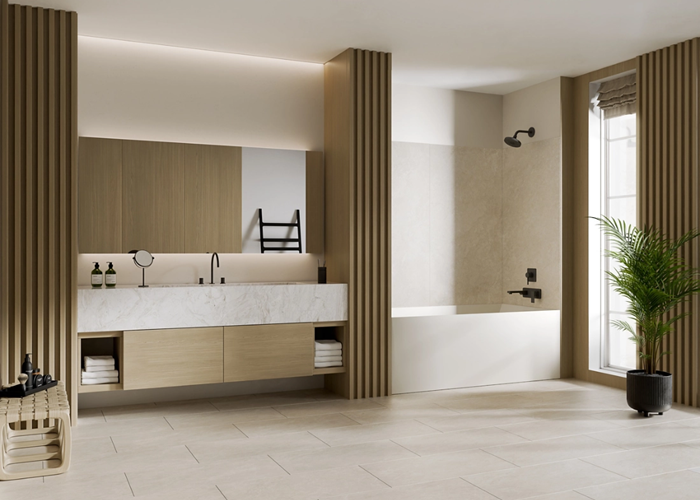
Large format porcelain panels offer a sleek, seamless look that clients love—but they require precision and planning to install correctly. Whether you're working on walls or floors, these pro tips from The Tile Shop can help ensure a smooth installation and a flawless finish.
1. Start With a Flawless Substrate
Large format panels demand a flat, clean, and stable substrate—no exceptions. Check for lippage, uneven surfaces, or gaps.
- Walls: Correct uneven areas with shims or skim coat as needed.
- Floors: If floors are not flat, use primer followed by self-leveling compound to create a flat base for floor installations. If the floor is already flat and leveler is not needed, primer is not required.
Always follow manufacturer guidance, and ensure that your surface is dry, clean, and properly prepared before setting panels.
2. Choose the Right Mortar
Large format panels require a mortar that offers excellent coverage and bond strength and is rated for use with large-format tiles. For walls and floors, look for mortars labeled “non-sag” and “non-slump,” respectively.
3. Euro-Notch Trowels Are Preferred
A Euro-notch trowel is ideal for applying mortar to substrates and panels. Its rounded edges help thinset ridges collapse more easily, allowing trapped air to escape and reducing voids beneath panels. If you’re using a square-notched trowel instead, make sure it’s the right size to achieve full coverage for your panel’s dimensions. And always back-butter each panel to ensure full coverage.
4. Cut Clean, Cut Smart
For clean, precise cuts, use a manual rail cutter system designed for large-format panels. Begin with a back score to guide the full score, apply consistent pressure, and support the cut with a second person to avoid splintering. For outlets or valves, use diamond drill bits, and always sand edges carefully to prevent injury.
5. Lift, Move, and Set With Care
Large-format porcelain panels are heavy and fragile under stress. Installation is rarely a one-person project, and communication is key. Use suction cup tools, lifting frames, and a team install approach, and communicate continuously throughout handling to avoid missteps and breakage. Tub-sized wall panels can be handled by one person in some cases, but floor applications and larger formats will always require multiple installers.
6. Work From the Center Out
Once a panel is placed, you'll need to collapse the air channels in the mortar. Whether you’re installing on walls or floors, start at the center spine running the length of the panel and work outwards, avoiding the outer 2” of each side. For walls, tamp the panel in place; for floors, step onto the panel and "walk it out." After addressing the center spine, apply even pressure to the remainder of the panel in four quadrants, frequently returning to center.
7. Mind Your Movement Joints
Expansion and movement joints are critical for preventing stress cracks, especially in large installations. Follow ANSI and TCNA guidelines for placement based on interior conditions and substrate material.
8. Plan for Grout and Transitions
Precision is key—dry lay panels first to confirm grout joint placement, pattern alignment, and transitions. On floors, pay special attention to where panels meet thresholds, drains, or other flooring materials.
9. Don’t Rush the Cure
Allow thinset mortar to cure fully before walking on or grouting panels. Rushing this step can compromise bond strength and lead to failures. Always refer to the manufacturer's instructions for cure times.
Everything You Need, All in One Place
From large format porcelain panel kits and individual porcelain slabs to drains, adhesives, and tools, The Tile Shop has everything you need to complete your next panel installation.
Visit your local showroom or tileshop.com to learn more, and unlock exclusive trade pricing with Tile Shop Pro Rewards.